

Your top news on media and advertising
Provided by AGP
Kevin St Clergy Appears as Guest on Success Today with Jack Canfield; Aired on ABC, CBS, NBC, and FOX Affiliates
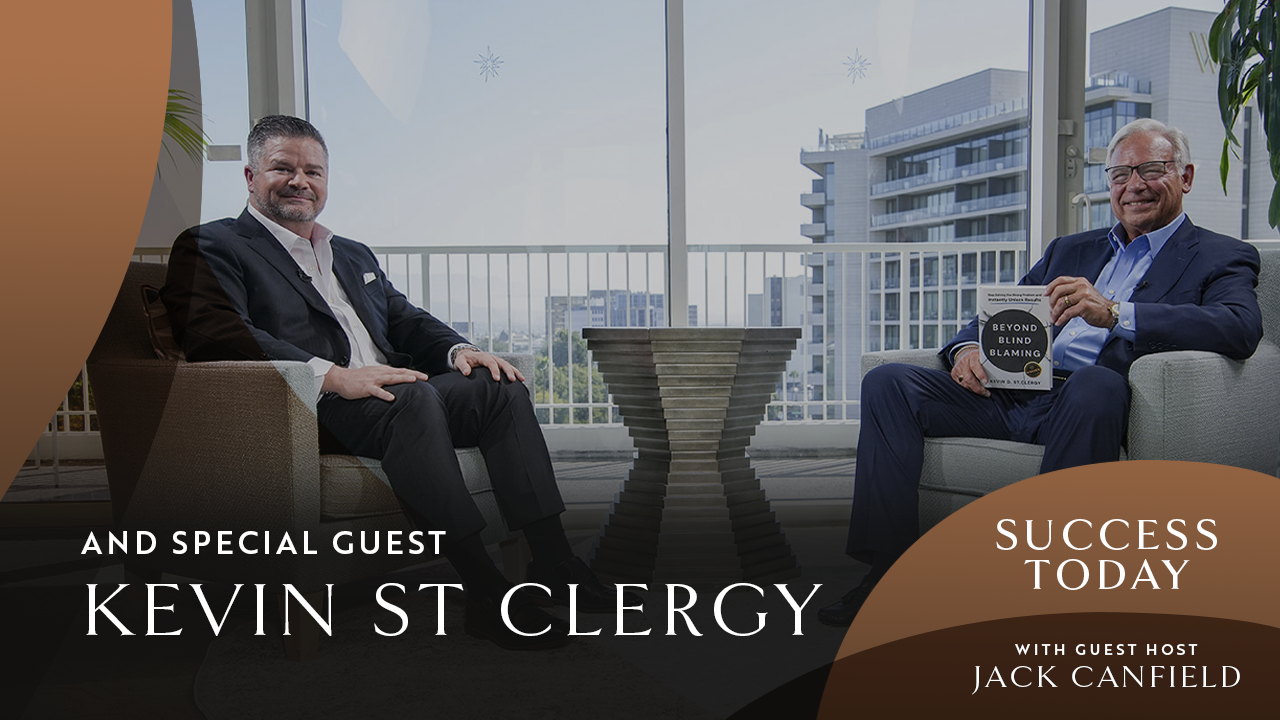
Beyond "Blind Blaming": Kevin St. Clergy & Jack Canfield on Why Most Business Failures Are Misdiagnosed
BEVERLY HILLS, CA, UNITED STATES, May 8, 2026 /EINPresswire.com/ -- Kevin St. Clergy, author of Beyond Blind Blaming and former digital marketing entrepreneur, guest stars on Success Today with Jack Canfield, airing on ABC, CBS, NBC, and FOX affiliates across the country. Filmed in Beverly Hills, California, by an Emmy Award-winning team, the episode follows Kevin's journey from building and selling a multi-million dollar marketing agency to identifying a common breakdown: people often address the wrong problem.
Kevin's insight has deep roots and comes from a precise early experience. At 10 years old, he was a standout baseball player, hitting .550. Within a single season, that performance collapsed to zero. Coaches and parents assumed the cause was effort, focus, or attitude. It wasn't. A later eye exam revealed he could barely see. The issue had never been performance: it was vision. Until the belated diagnosis, he had to endure a barrage of criticism and misguided assumptions about his motivation and discipline, until the true source of his struggle was revealed. This early episode fundamentally shaped his understanding of failure and the danger of misattribution.
As Kevin explains, "At no point did anyone stop blaming me for something that was completely out of my control." The insight became foundational: people assign blame based on what they think is happening, not on what actually is.
The same pattern appeared years later in his professional career. After scaling a digital marketing company to 450 clients across 900 locations and exiting in a life-changing sale, Kevin began advising other business owners. He noticed a consistent contradiction: clients changed strategies, tools, and systems, yet their results remained unchanged. What they adjusted was visible. What drove the outcome was not.
This led him to formalize the concept he calls "blind blaming." Instead of asking how to fix a problem, he shifted the question to whether the problem had been correctly defined in the first place.
To address this recurring problem, Kevin developed the RCD Method: Reflect, Connect, Decide. The first step, Reflect, asks you to pause and question whether your assumptions are masking deeper causes. Connect, the second step, means deliberately seeking input from outside your usual circle — since people in the same environment often share the same blind spots. Mentors, coaches, or peer groups can provide a missing perspective. The third step, Decide, is about moving from insight to action: choosing a concrete next step, rather than staying stuck in analysis. Without action, even the sharpest insight remains irrelevant: "At some point, you just have to make a decision," he says, describing the moment where analysis stops, and movement begins. Without that shift, insight never converts into progress.
Kevin illustrates the method with specific cases. In one example, a business owner was losing customers, missing deadlines, and frustrating his team. Everyone around him assumed the issue was discipline: he needed better time management, tighter scheduling, or more focus. His business partner even hired an ADHD coach to address what appeared to be a productivity problem. After months with no improvement, the coach recognized something didn't add up and referred him for medical testing. The diagnosis was sleep apnea. He wasn't disorganized — he was chronically exhausted. Once treated, the change was immediate. Energy returned, decision-making improved, and the business scaled rapidly, eventually growing five times over and leading to a successful exit. The problem had never been execution. It was a hidden cause that no amount of planning could fix.
Rejecting superficial fixes, he pivoted to investigating root causes. His methodology prioritizes understanding the drivers of behavior over simply correcting it.
Canfield, whose work has reached over 500 million readers worldwide, echoed the core of Kevin's methodology: "Most people don't struggle because they lack effort; they struggle because they're solving the wrong problem."
Underlying the method is a redefinition of success. Earlier in his career, Kevin measured it through income and financial independence. That has deeply changed. "Success now is impact, it's the number of lives I can positively affect," he explains.
This approach reflects a broader shift. In an environment saturated with information, the constraint is no longer access to knowledge. It is the ability to identify what actually matters. Misidentifying the problem leads to frustrating efforts that don't change the results.
Kevin's work suggests that clarity will become more valuable than complexity. Those who can isolate root causes rather than react to symptoms will evolve faster, waste less effort, and produce more consistent results.
Success Today with Jack Canfield features in-depth conversations with entrepreneurs, leaders, and changemakers. The program explores the decisions, habits, and mindsets behind their success. Through personal stories and practical insights, it offers an intimate view of how they overcome challenges, seize opportunities, and define success on their own terms. Tune in to be inspired and discover strategies you can apply to your own journey toward success.
Katie Tschopp
Astonish Entertainment
email us here
Kevin St Clergy: Uncovering the Hidden Causes That Hold People Back
Legal Disclaimer:
EIN Presswire provides this news content "as is" without warranty of any kind. We do not accept any responsibility or liability for the accuracy, content, images, videos, licenses, completeness, legality, or reliability of the information contained in this article. If you have any complaints or copyright issues related to this article, kindly contact the author above.
